


Aristopets already existed in Ancient Egypt. Dogs and cats were very, very beloved. Egyptians cared for and pampered them, more or less as we aristoparents do today.
EThe dog was already man's best friend, the most loyal companion in the home and also the best comrade in hunting. While the cat started as an effective hunter of mice, snakes, and other unwanted animals in homes and barns. But thanks to that, it earned the affection and sympathy of the peasants, and became another guest in the house.

Pets lived near their owners and received all kinds of care during their earthly life (as revealed by the study of animal mummies): shiny fur and strong bones reveal continuous, healthy and balanced nutrition.
The celebrated Greek historian Herodotus of Halicarnassus visited Egypt in the mid-5th century BC and stated that "domestic animals were abundant." He himself testified to the great desolation that the death of a pet caused among the inhabitants of the house. So much so that when a cat died, family members shaved their eyebrows as a sign of mourning. When a dog died, they shaved their entire body, up to their head. Can you imagine?
Since the image was attributed magical and religious power in pharaonic Egypt, upon death, Egyptians had themselves represented alongside their pets on the walls of their tombs, on funerary stelae and in sarcophagi. It was believed that they could thus happily continue together in the Afterlife. In fact, from the New Kingdom (1552 BC), the cat appears represented on the walls of its owners' tombs with greater frequency. To judge by the images, this animal became the favorite pet of some members of royalty, such as Queen Tiye, Princess Satamun, or Prince Thutmose, eldest son of Amenhotep III, who ordered a stone sarcophagus with beautiful reliefs and inscriptions for his beloved cat Tamit.
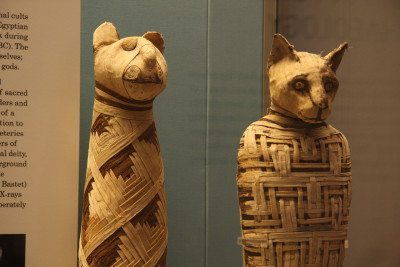
Furthermore, when they died, some pets were carefully mummified. The corpse was placed on a special embalming table to extract its internal organs. Once extracted, the viscera were cleaned and rinsed with aromatic substances, and were placed back inside the abdominal cavity. Previously, the body had been desiccated with natron (a type of salt) and filled with myrrh, cinnamon and other products. Immediately afterwards, ointments made from resins, gums and perfumed oils were applied, and the body was wrapped with linen bandages. Once the process was complete, the embalmed pet was placed inside a coffin or sarcophagus and buried near its former owners.
Given that the cost of embalming was considerable, a pet being mummified indicated that it had been extremely loved and important to its owner.
Although practices have changed, undoubtedly the current need to keep our pets close, even if they are no longer with us, is something that we have inherited from the ancient Egyptians.
If you want to know more about this exciting topic, don't miss the following video: