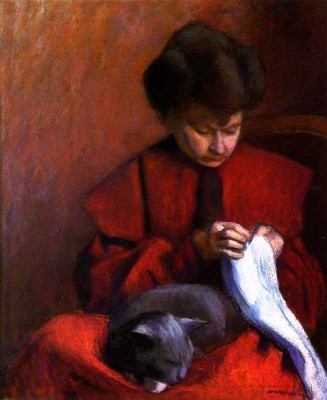
After researching Impressionist and Post-Impressionist works with ARISTOPETS, we travel to 1905, specifically to the Autumn Salon in Paris, where the first Fauvism exhibition was presented.
Fauvism was a movement full of spontaneity and freshness. The artists of the movement challenged the conventionalisms of the time, rejecting established rules and methods. The Fauves believed that they could express feelings through colors, and this influenced their way of painting. The artists of this movement did not seek perspective or realistic representation.
The main artists of the movement were Henri Matisse, André Derain, Maurice de Vlaminick, Henri Manguin, Albert Marquet, Jean Puy, and Emile Otón Friesz. Later, George Braque and Raoul Dufy joined. But, among these artists, who painted ARISTOPETS in their works? Let's find out.
Henri Matisse
This artist was considered the creator of the movement. In his works, the use of color predominated, a medium through which he tried to express his feelings. The figures are flat, linear, enclosed in thick outline lines.
The Cat with Red Fish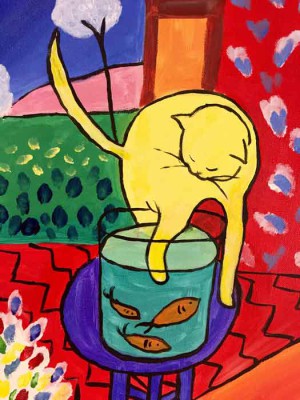
Tea in the Garden (1919)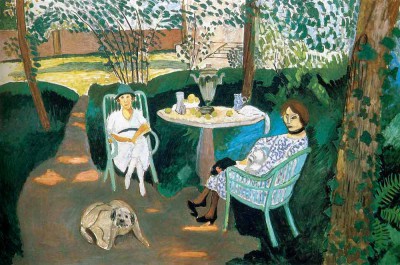
Girl with Black Cat (1910)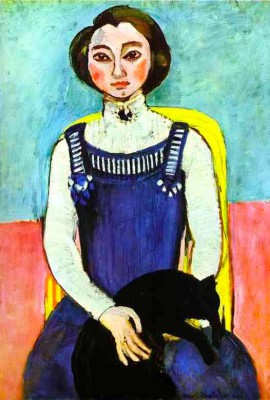
Interior with Dog (1934)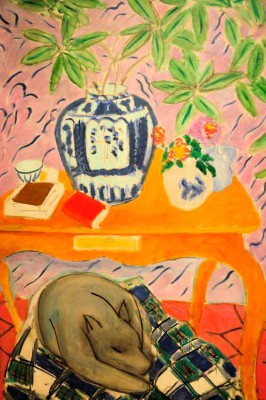
André Derain
The works of this artist are characterized by the representation of rural and urban characters, such as this painting of a painter and his family. The colors are pure and the brushstrokes irregular.
The Painter and His Family (1939)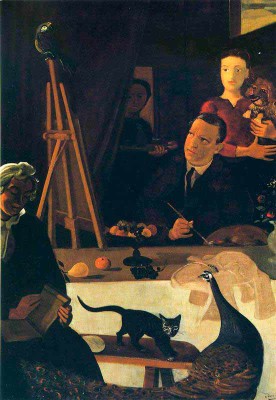
Maurice de Vlaminck
He was the most radical and revolutionary of the movement. His work is based on the use of pure colors, simplifying forms. He applied colors with fragmented brushstrokes.
Woman with a Dog (1906)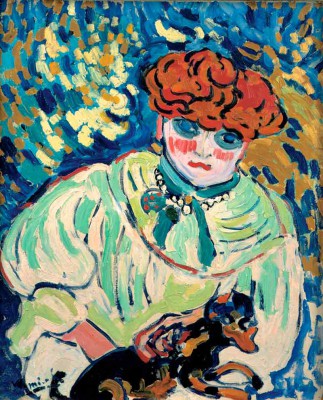
Albert Marquet
Marquet used dull yellow, muted violet or blue colors, and only used black to achieve strong contrasts with light colors to create shapes. Although he belonged to this movement, he followed a more independent current than the rest of the group. His works predominantly feature landscapes, portraits, and female nudes.
The Artist's Mother (1906)