


Alzheimer's is a progressive, irreversible, non-contagious brain disease that alters personality and, as a result of neuronal death, gradually destroys a person's memory, as well as their ability to learn, reason, make judgments, communicate, and perform daily activities.
Alzheimer's patients gradually lose their memories and identity until they no longer recognize the reality around them. The disease lasts between 7 and 15 years. During this time, the patient's impairment and dependence steadily increase. It is considered an epidemic with no cure. There are more than 46 million people affected worldwide. A new case is diagnosed every three seconds, and it is estimated that by 2050, if a cure is not found, the number of cases will have tripled.
The main risk factor for Alzheimer's is aging. As life expectancy has increased worldwide, so has the number of Alzheimer's patients.
Currently, there is no cure (and we hope one is found soon), but there are therapies that help delay or mitigate the effects of the disease. Among these is dog therapy.
It is known that pets improve people's quality of life. Many studies already corroborate the benefits of assisted dog therapy in elderly people with Alzheimer's or other dementias. The main objective of these non-pharmacological treatments is to improve the quality of life of the elderly, focusing on four fundamental areas: physical, cognitive, emotional, and social. Animals thus become the best medicine for patients, whose mood significantly improves with simple contact with the pet. Likewise, dogs can be the necessary stimulus for seniors to overcome emotional and social losses, and in some cases, even improve their mobility.
The Oms-Sant Miquel Residence in Mallorca has been using this treatment for more than three years, and you only have to look at the images to understand how much good animals do for affected seniors:
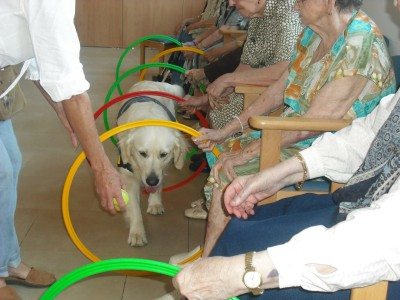
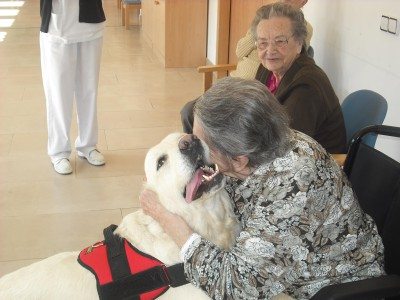
In these cases, the dogs used in this therapy are trained for months to become socialized. For the animals to perform this wonderful work, they must first demonstrate an instinct for contact with people, as well as a retrieving instinct, which is necessary for the various games played with them. Additionally, logically, they must have a calm temperament. This is why they are usually medium or large breeds, and preferably Golden or Labrador Retrievers.
The chosen dogs are taught to retrieve objects and place them in different locations (in the patient's hand, on the floor, or on their lap), depending on what is intended to be worked on with the patient (movements, gestures of gratitude towards the animal, etc.). They are also taught to interact with affected individuals through games, which on one hand captures these people's attention, and on the other helps them remember basic things like numbers, colors, or letters. With all this, dogs encourage the expression of emotions, as well as a feeling of usefulness, while also relaxing and socializing the patient.
We encourage you to watch this beautiful video, in which we witness a dog-assisted therapy session against this cruel disease.