Those of us who live with an ARISTODOG know how intelligent and clever they are. We've always said it to anyone who would listen, but it seems that until science gives us the green light, our statements are nothing more than "ARISTOPARENT love."
Well, it turns out that three researchers, members of the Department of Ethology and the Comparative Ethology Research Group at the University of Budapest, have developed a study, published just a few days ago in Current Biology, which demonstrates that dogs not only remember what they do themselves, but also what their ARISTOPARENTS do.
The study works on what is called "episodic memory," which is the memory that allows us humans to remember things we don't consider important at the moment they happen. And the question was to find out whether dogs have it or not.
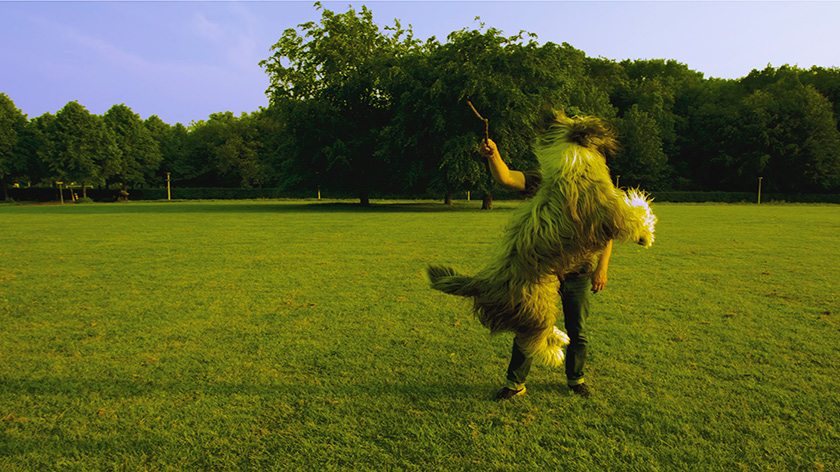
To do this, 17 dogs of different breeds, including mixed breeds, were trained. Using the method called Do as I Do, the dogs learned to match their behavior with what the humans had shown by giving the command "Do it!". Or, to put it simply: the owner jumped, then gave the command, and the dog jumped too. The animals trained in this way could imitate their owners' actions even 24 hours later. This means that giving the command "Do it!" after a while is somehow equivalent to asking them, "Do you remember what your owner did?"
To investigate episodic memory, it was necessary for the imitation test to be unexpected for the dogs. So they were re-trained to modify their expectations of receiving the imitation command. Regardless of the actions performed by the owner, they were ordered to lie down. In this way, they were taught that the actions shown to them were no longer relevant, because whatever act the owner performed, the dog was always ordered to lie down. Then, after ensuring that the dogs no longer expected the imitation command, they were shown everyday actions, and after a while, they were surprised by being given the command: "Do it!".
The fact that dogs can remember and imitate when unexpectedly tested means that they use a memory similar to episodic memory to recall everyday tasks. Therefore, the research concludes that dogs remember not only what they do, but also what we do.
Other species, such as primates, rats, and pigeons, had already shown evidence of possessing a memory similar to episodic memory. But it was not yet known that animals could use episodic memory to remember complex events, such as real-life situations. Hence the importance of this study. It is the first to examine whether dogs in their natural environment can remember complex and content-rich events, similar to those that occur in real life. Likewise, this is the first research that studies the memories of the actions of others, not performed by the subjects themselves. Hence its relevance. If you want to know more about the study, click here.
So if you were convinced that your ARISTODOG was capable of repeating what you do, if you were convinced that they had an amazing memory, you were right. Our daily lives and the physical and emotional closeness with our ARISTODOGS make us know more about them and understand them better than anyone. So we could say that friction not only creates affection (unconditional love), but also provides knowledge.