


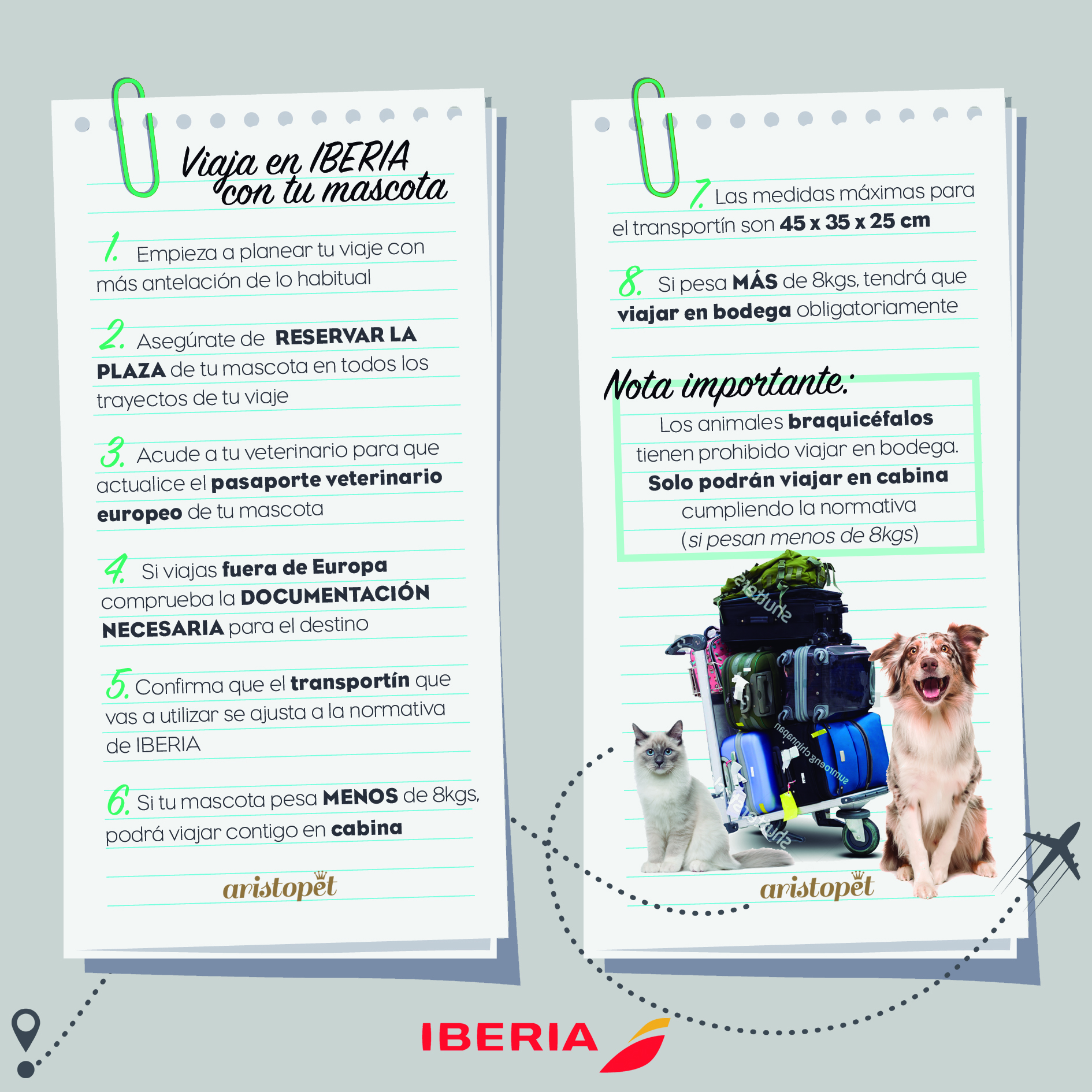
When it comes to flying with their pets, many ARISTOPARENTS feel overwhelmed with doubts. At ARISTOPET, we have prepared a brief guide on how to travel with IBERIA, the world's most punctual airline.
Our first piece of advice if you plan to take your pet with you on your next vacation is to plan your trip further in advance than usual. This will help you process all the necessary documentation and secure your pet's spot on the plane, especially if you are flying outside of Europe. Having this extra time will be very useful for easily resolving any unforeseen issues.

It is important to be well-informed about the documentation you need to fly with your pet, as it can vary depending on the destination country. The essential requirements are that your pet has a microchip and that you carry a valid European pet passport.
For Europe, the passport will be sufficient. However, if you are traveling abroad, you will need other documents. Regarding cats, it is mandatory that they are vaccinated against rabies, and you must consider the timing, as some countries require them to have been vaccinated months in advance. Other countries may also require specific deworming treatment, or your pet might have to undergo a quarantine period if it's a very strict country, such as Thailand.

Remember that to travel with your pet, you need to book their space in advance. Each plane has limited spots for animals, so all trips must be pre-authorized by the airline.
Your pet can fly in the cabin or in the cargo hold. If it weighs less than 8 kg—including the weight of the carrier—you can take it with you on your lap, at your feet, or under your seat. The maximum permitted dimensions are 45 x 35 x 25 cm. Several pets of the same species can travel in the same carrier as long as the total weight does not exceed 8 kg. Of course, you must be very attentive to your animal's needs and ensure it is not a nuisance to other passengers.
If your pet weighs more than 8 kg, it must travel in the cargo hold. The maximum dimensions of the carrier depend on the plane you will be traveling on.
The carrier, regardless of where your animal will travel, must be suitable. It needs to be rigid, sturdy, well-ventilated, and appropriately sized for your pet. It also needs to have a waterproof bottom and a secure latch. If the carrier does not meet the established conditions, its transport may be denied at the boarding gate, so keep these in mind.
Don't worry if you can't take your pet with you in the cabin; animals flying in the cargo hold are transported in a special, pressurized compartment adapted to their needs. To help them travel more calmly, make sure to put a toy or their favorite blanket in the carrier.

SPECIAL CASES: For their safety, brachycephalic cats and dogs (bulldog, pug, boxer, Persian, etc.) cannot fly in the cargo hold on IBERIA flights. These animals have delicate respiratory systems, and the journey can be harmful to their health. They can only travel in the cabin if they weigh less than 8 kg, including the carrier.
Dogs classified as potentially dangerous (pitbull terrier, rottweiler, etc.) must wear a muzzle when outside their carrier.
Regarding prices, they range from €25 to €300 (per leg). We recommend checking them before traveling, as these rates are indicative and subject to change.