


The Great Dane, also known as the German Mastiff or German Boarhound, is a dog breed known for its large size and gentle personality. The Fédération Cynologique Internationale considers it the "Apollo among all breeds."
Indeed, it is a fascinating dog that has always been by man's side throughout the centuries. During this time, it has performed roles as a hunter, guardian, protector, and, of course, ARISTODOG.
As early as Ancient Egypt, we find effigies of dogs similar to mastiffs in the tombs of pharaohs; in Assyrian bas-reliefs, in big game hunting scenes; the ancient Romans, in addition to the Molossus used in combat, had other dogs, equally large but more agile: we probably owe to them their spread throughout Europe, including Britain. In prints and engravings from the medieval period, from different European countries, we find depictions of dogs that are undoubtedly German Mastiffs.
They were thus appreciated and then bred especially in Germany, and the Germans knew how to improve the breed, partly thanks to crosses with local dogs. The product of these crosses was initially called the English dogge, but they soon made it their national breed, probably thanks, among others, to the famous chancellor Otto von Bismarck, who was often seen accompanied by dogs of this breed.
However, according to some authors, this name does not derive from the country of origin (it is interesting to note that there is no news of particular attention to this breed from the Danes), but from the fact that these dogs were mainly cinnamon-colored, that is, blond, without a mask, with long legs and a strong trunk. That is, the same characteristics attributed to the inhabitants of Denmark.
In the second half of the 19th century, the name deutsche dogge (i.e., German dog) was definitively coined. And meanwhile, it became a "national breed" and it was established to breed all these dogs under a single name that differed little from each other, except for the coat color. Therefore, it is impossible to determine the exact place of origin of this breed or the variety of dogs that have contributed to its formation, although the place where they became great as a breed can be identified.
What is the Great Dane like?
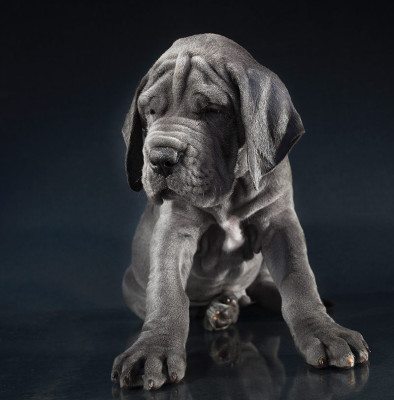
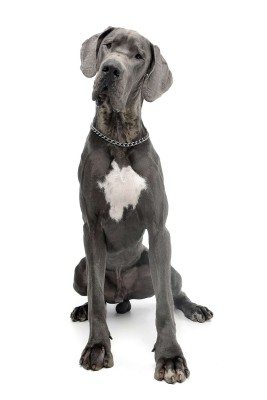
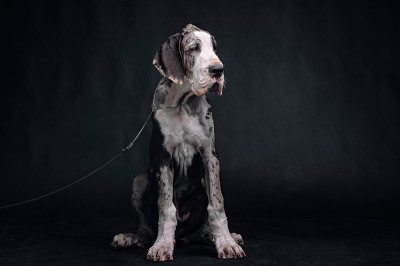
The Great Dane is bred in three independent varieties: fawn and brindle, harlequin and black, blue. All of them with a short, dense, smooth, and shiny coat. And all of them with the aristocratic appearance that characterizes this breed.
Its entire body conveys pride, strength, and elegance. Despite its large proportions, it is a balanced and agile dog. For males, the weight ranges from 54 to 90 kilograms, and the height at the withers is a minimum of 80 centimeters and a maximum of 90. For females, their weight reaches between 45 and 59 kilograms, while their height at the withers is around 72 and 84 centimeters.
It has an elongated and narrow head, held high, on a long, dry, muscular neck. Also noteworthy is its broad rump with strong musculature, which the youngest members of the household are often tempted to ride. The tail is very expressive; at rest, it hangs downwards forming a natural curve. When excited or during movement, it takes on a slight saber-like carriage.
Its face features a well-developed nose, wider than round, generally black. Its muzzle is deep and as rectangular as possible. Its jaw is broad, strong, and well-developed. The cheek muscles are slightly marked. Naturally, its ears are pendulous and tend to rest on its cheeks.
Its eyes are medium-sized, but we love their lively, intelligent, and friendly expression. They say it all with just one glance.
Despite its giant proportions, the Great Dane has harmonious, agile, elastic movement and is capable of covering a lot of ground. Watching it walk, with that style and presence, is a pleasure.
How does the Great Dane behave?
Despite its large and imposing size, those who know it know that it is actually a friendly, affectionate, and devoted dog to its ARISTO-PARENT. It can be somewhat reserved with strangers, but that soon passes as it gains confidence. As a companion dog, it is a fantastic dog. Affectionate, self-confident, not easily startled, and docile, if it receives the treatment it deserves.
How to care for the Great Dane?
Due to its large size, the Great Dane thrives best in spacious areas, where it can exercise and feel freer. However, if it lives in apartments or confined spaces, there isn't too much of a problem, as long as it gets a considerable amount of time each day to exercise, get tired, and maintain its inner balance.
Likewise, as a dog traditionally accustomed to performing hunting and defense tasks, the Great Dane requires training with a high stimulation threshold. It needs to feel useful and active; it likes to have "its place" in the home.
We hope you enjoyed learning more about this beautiful and enormous ARISTODOG. If you want to continue reading about other breeds, click here.