


It seems that this is what a group of scientists and several animal welfare organizations have thought to launch a pioneering plan in Washington D.C. We are going to talk about this protocol today because, on the one hand, it highlights the inability of administrations to effectively and respectfully address cat overpopulation. And on the other hand, it shows the willingness of "anonymous" people to do something to improve the lives of pets.
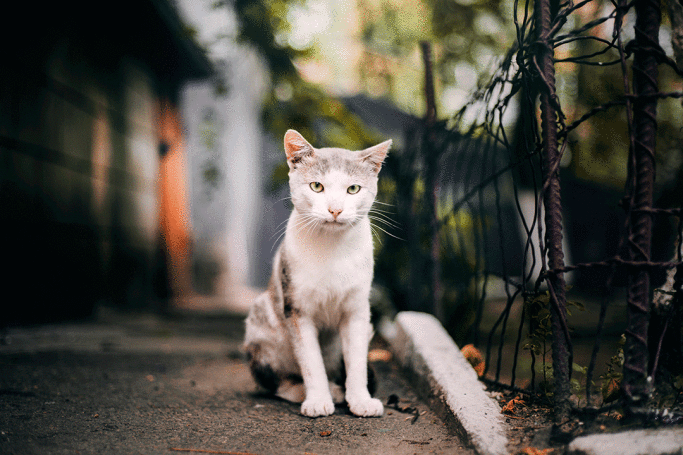
As we have said on more than one occasion, unwanted litters are the main cause of animal abandonment. So, if we add the number of abandoned cats to the cats already born in the street, unsterilized domestic cats that leave home and fertilize street cats, etc., the number of kittens born in a year totals thousands worldwide.
Some believe that cats have taken over the streets, that they eat birds, and that they transmit dangerous diseases to humans. There is a smear campaign against cats, when it should be against those who abandon, mistreat, and neglect them. Angry people who believe felines are a problem in cities, when in reality, the poor creatures do no harm, quite the opposite.
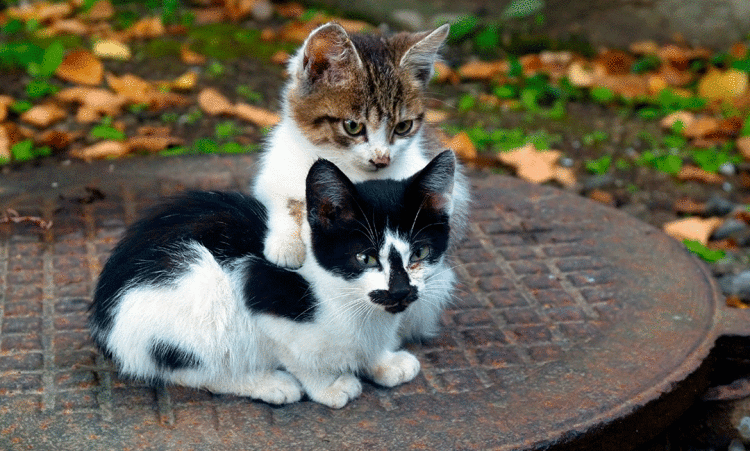
Well, in Washington D.C., a collective of scientists and animal rights activists have said "not so fast" and decided to invest one and a half million dollars to count all the felines in Washington D.C. The objective is to provide truthful and solid information to institutions before they take any hasty anti-cat measures in response to pressure from certain social groups.
Over the next three years, the D. C. Cat Count project will conduct a cat census, which will include stray cats, but also domestic cats. This count will be carried out with the help of neighbors and citizens, as well as professionals who are part of the entities and organizations participating in the study. And it will consist of several phases:
1. First, a network of 60 cameras with infrared sensors will be installed. They will be distributed throughout the city to collect information from public roads, parks, and vacant lots, where most feline colonies are located.
2. Secondly, door-to-door and household-by-household surveys will be conducted throughout the city (a task that two full-time people will be dedicated to) to count the number of feline pets living with Washington families.
3. Thirdly, an app is planned to be launched so that residents can upload photos of their felines, as well as those they see on the streets. Thanks to this, the count will be massive and will be able to reach corners where cameras and dedicated teams are unable to reach.
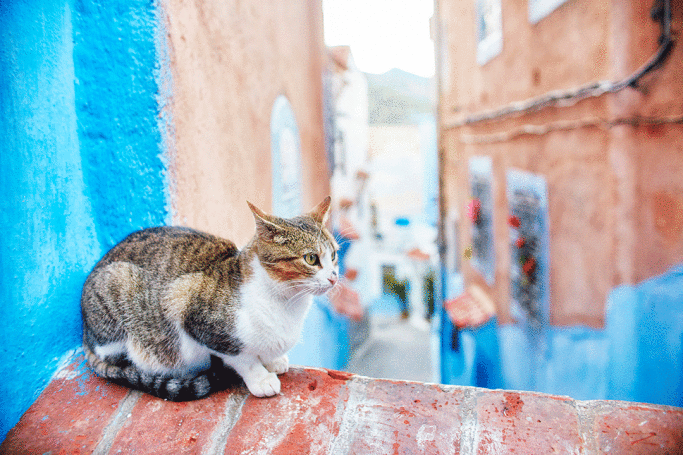
In this way, three reliable and independent sources are available for a valid count that can serve as a model for other cities in the world facing the dilemma of cat overpopulation.
It should be remembered that there are 86 million domestic cats in the United States — one for every 1.5 households — and between 30 and 40 million stray cats, according to figures from the Humane Society. Thanks to this novel count, it will be possible to know how many there really are in Washington and to elucidate the needs of cats, and how to help shelters better manage their resources. Something that has not been taken into account by the administration until now. The current operation consists of trapping, sterilizing, and releasing cats. A protocol whose efficiency is systematically questioned by "cat lovers" but also by animal welfare organizations. Efficiency aside, there is no doubt that it is not the cheapest measure for feline control. Nor is it the most respectful.

The results of the cat census will be presented, if all goes as planned, in June 2021. So we will continue to report on how things are going for felines in Washington D.C.