


Our ARISTOCATS are fascinating. We could watch them for hours, trying to understand why they do what they do; where all that originality comes from, that "je ne sais quoi" that makes them irresistible. There are things that respond to each cat's personality and character. To their essence. Each cat is a world unto itself. Period. But there are other things for which science has an answer... more or less.
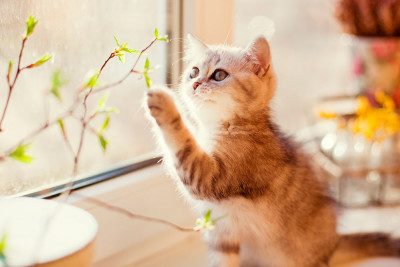
For example: why, when you play with your cat, does it always tend to use one of its paws first? Or why does it usually catch toys or food with one of them? Why does it start descending stairs with the same paw? Coincidence? Just your cat's quirks?
In the case of humans, research into left- or right-handedness has been ongoing for many, many years. So, today it is known that 90% of people are right-handed and use their right hand to write or brush their teeth.
In the late seventies, research began to study other animals. Did they prefer to use their left paw or fin, or their right? These studies examined primates, of course, but also dogs, kangaroos, and even whales. And tiny worms.
Now it's time to study cats. And science tells us that nothing is by chance. According to the latest research, the preference your cat shows for using its left or right front paw is largely determined by your pet's sex. Apparently, males prefer to use their left paw, while females tend to use their right. The connection is made. It's due to sex hormones.
How was the research conducted?
The research, as published in Animal Behaviour, took place in homes in Northern Ireland. There, researchers observed 44 domestic cats, for three months. 20 of them were females.
Over that time, four behaviors were observed:
- Which paw they first put into the litter box.
- Which paw they started descending stairs with.
- Which side they usually lay on.
- Which paw they used to try and extract food from a plastic feeder.
The results showed that nearly 75% of cats had a preferred paw. And, specifically, females clearly preferred their right paw. While males tended to be left-pawed.
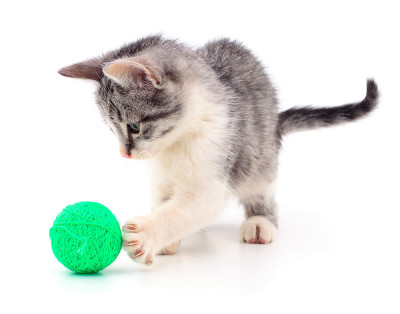
How to tell if your cat is left- or right-pawed?
Basically, as you've seen, it's a matter of observation. You just need to consider the four aspects above and rigorously note in a notebook (or spreadsheet) which paw predominates at each moment. Establish this routine for a few months (3, if you want to be as faithful as possible to the research) and at the end you will have enough data to know your cat's preference.
However, remember that not all cats show such a clear preference (some are ambidextrous, as we say of people). If this happens, it is very important that you do not force a response from your cat to try and make the balance tip in one direction. That would be unnatural.
What is this information for?
Clearly, it's a way to better understand and get to know your cat, so that it, in turn, feels better and more cared for. And that is the main purpose of this research.
As previous research has shown, especially with dogs, left-pawed or ambidextrous dogs tend to be more stressed and fearful than right-pawed ones. Therefore, this biomarker can give us many clues about how ARISTOPETS handle stress and anxiety and, consequently, help them live better and enjoy greater well-being.
We encourage you to do the experiment and tell us the results very soon on our social media.