


Getting to know the American Curl better
The American Curl breed originated naturally from a genetic mutation, just like the American Curl Longhair. They only differ in their coats — short or semi-long, respectively — and because the Longhair has a beautifully plumed tail. Although it is a relatively young breed, it is very popular and appreciated in America. In Europe, the craze for American Curls has not yet exploded — for now.
The first appearance of the American Curl Shorthair dates back to 1981 and occurred in California. A curious cat named Shulamith appeared at the home of professional breeders Joe and Grace Ruga. The couple was surprised by the animal's unique ears, as they had never before seen ears so curved and small. The couple decided to keep this beautiful specimen and try to breed it while maintaining the peculiar ears. To everyone's astonishment, of the small kittens born, only half of the litter developed the characteristic curled ears, and the other half had normal, straight ears. When Joe and Grace presented the cat to society, it sparked great interest, and many breeders supported the development and study of the specific gene that caused the ear curvature. At this point, Roy Robinson — an English cat geneticist — got to work. In 1989, he published an article in the Journal of Heredity detailing his findings about the fact that intrigued so many: why did this mutation develop in the ears? He studied 81 litters with a total of 383 offspring and concluded that what caused this curvature in the ears was a dominant gene. In his article, Roy Robinson also mentioned that the breed showed no signs of defects, so they could continue to develop it. In 1991, the CFA recognized the American Curl Shorthair breed as such, and subsequently, in 2002, the FIFE did so.
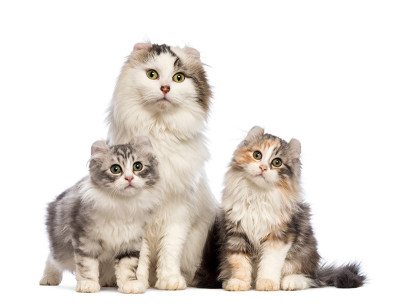
What is the American Curl like?
The American Curl is a medium-sized cat, somewhat heavy and with a rectangular body. Its head is crowned by its easily recognizable small, curled ears that curve backward (hence its name, as "curl" means curl), which makes them always seem expectant and alert. From these ears emerge graceful tufts of hair that give it that adorable uniqueness. As a curious note, it is worth mentioning that their ears begin to curl from 10 days of age. At four months, the ears already acquire their permanent shape, and may have curled more or stopped doing so.
Another very characteristic feature of this cat is its beautiful walnut-shaped eyes, oval at the top, which irresistibly sweeten its gaze. Its nose is short, and its muzzle is bulky and fleshy.
Its coat is shiny, short, and silky to the touch. The color range varies from light tones such as white, cream, and silver, to tones such as black, blue, red, lilac, and even gold, tabby, or tortoiseshell. All colors are accepted except chocolate and cinnamon and their tonal varieties. Its tail is long, flexible, rounded at the tip, and well-proportioned to its body.
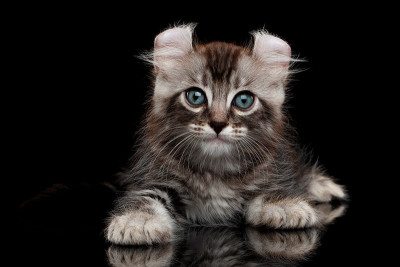
How does the American Curl behave?
The American Curl Shorthair is an affectionate and gentle cat. It easily coexists with other domestic animals, whether cats or other pets. It adapts easily to changes because it is a breed with a balanced and intelligent character. They are playful throughout their lives, especially with their ARISTOPARENTS, but also with children — with whom they are respectful and fun. It is also very positive that they do not usually meow.
They never tire of following their ARISTOPARENTS around the house while they carry out their daily activities — as if they were bodyguards. Because they love to bring out the detective in them. In fact, one of their favorite activities is to snoop around the house and not miss a detail, observe all family members, and, of course, be the center of attention from time to time.
To satisfy their thirst for an adventurous snoop, it is interesting for them to live in a home with access to the outdoors, because they love gardens — both their own and others' — and discovering what mysteries they hide.
How to care for the American Curl?
It is a docile cat that loves to go outside from time to time and discover what's new in the neighborhood. In that sense, if we don't have a garden, it is highly recommended to stimulate it with games that enhance its mental and physical health, enrich the environment of our home, and follow some simple guidelines that will surely help it be happy.
As for its health, special attention must be paid to its ears, ensuring they are clean and well-groomed. We must also be careful with the delicate cartilage of the outer ear of these ARISTOCATS and try to prevent them from adopting inappropriate positions. It is advisable to check them at least once a week. Otherwise, it is a strong and healthy breed that does not present any specific diseases.
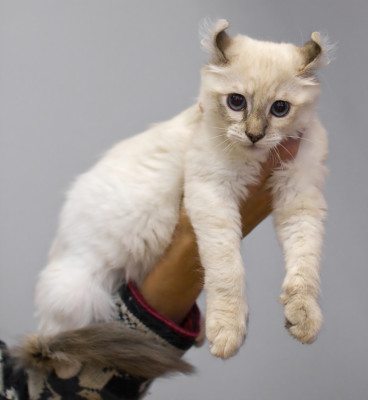
We hope that after getting to know the American Curl better, you like them as much as we do. If you want to meet more ARISTOCATS, you can continue reading about the Scottish Fold, the Ragdoll, and the Maine Coon.